
Uranium Glass
Glass with uranium melted into it, which turns it yellow-green in daylight and makes it blaze bright green under a blacklight. It is genuinely radioactive and genuinely harmless, the naming is a mess that changes depending on which country you're standing in, and the only reliable test is a UV torch.
Also called: Vaseline glass · canary glass · depression glass (some) · annagrün

What it is
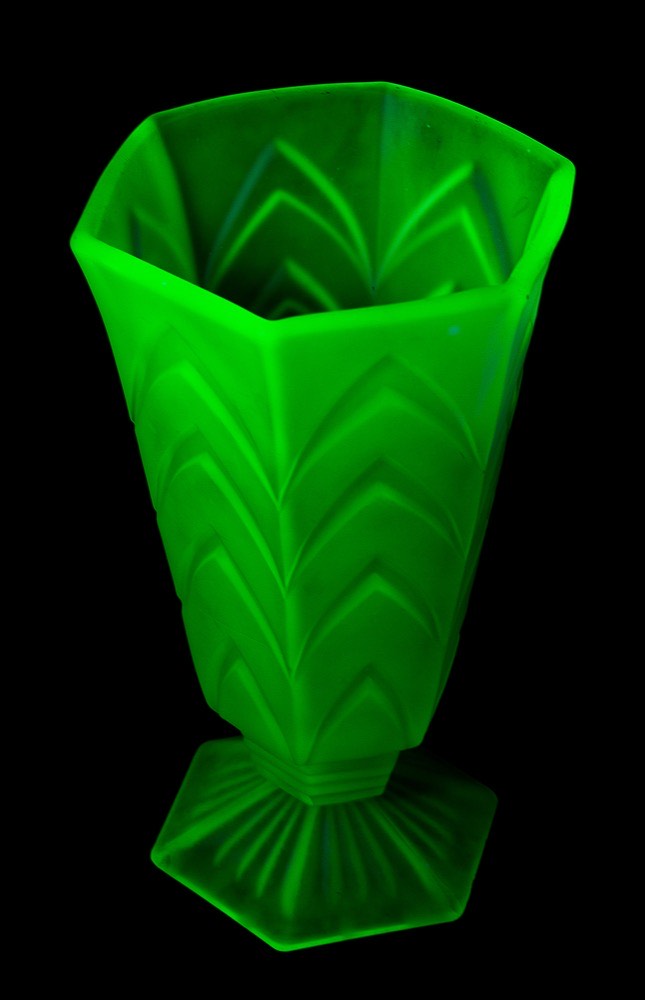
Uranium glass is ordinary glass with uranium — usually in oxide diuranate form — added to the melt as a colourant. The proportion normally runs from trace levels to about 2% by weight, though some 20th-century pieces were made with up to 25%.
In daylight it reads yellow through green, depending on the oxidation state and concentration of the metal ions. Under ultraviolet light it fluoresces bright green, and does so unmistakably — this is the whole reason the stuff was made, and the only dependable way to identify it.
It was never purely decorative, either. Uranium glass is still used by scientific glassblowers as an intermediate layer in a graded seal, bridging glass to metals like tungsten, molybdenum or Kovar alloys where the thermal expansion has to be stepped gradually.
A short history
Uranium was identified in 1789 by the German chemist Martin Heinrich Klaproth, and was being added to decorative glass for its fluorescence not long after. James Powell's Whitefriars Glass in London was among the first to market the glowing glass commercially.
Production spread across Europe and then to the United States, turning out tableware and household objects through the Victorian era and into the twentieth century.
Then the war took the raw material. US production of uranium glass stopped in the middle years of the Second World War when the government confiscated uranium supplies for the Manhattan Project — a restriction that ran from 1942 to 1958. When it eased, several firms resumed, including Fenton and Mosser, though uranium remained regulated as a strategic material. Restrictions were only lifted completely after the Cold War.
Finland's Riihimäki Glass produced designer pieces in uranium glass after the war. Older stock entered the open market once controls lifted, and small-scale new production has continued into the 2000s — which matters when you're dating a piece, because "it glows" does not mean "it's old".

Vaseline, canary, custard, jadite: the naming mess
This is where most confusion lives, and it is worth getting right because the words mean different things to different people.
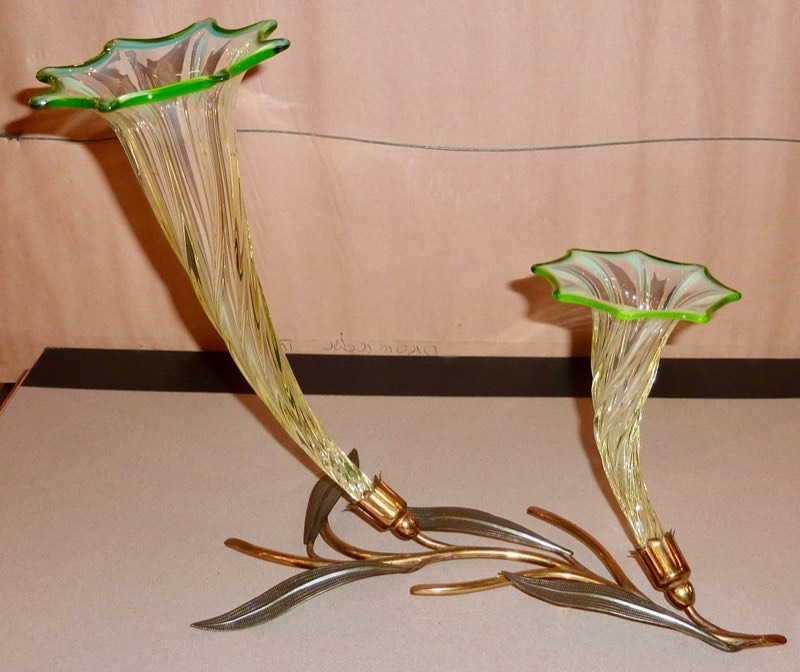
The most common colour is a pale yellowish-green, which in the 1930s earned the nickname "Vaseline glass" — it resembled the petroleum jelly of that era, which was yellow rather than the clear product sold today.
- Vaseline glass — the strict sense
- Specialist collectors use it narrowly: transparent or semi-transparent uranium glass in that specific pale yellowish-green. Nothing else.
- Vaseline glass — the loose American sense
- In the US it's often used for any uranium glass regardless of colour. Specialists frown on this, on the grounds that Vaseline was only ever yellow.
- ⚠️ Vaseline glass in the UK and Australia
- Different meaning entirely. There it can refer to any translucent glass at all, with no implication of uranium content. If you're buying across borders, confirm what the seller actually means.
- Custard, jadite, Burmese, depression
- Custard glass is opaque or semi-opaque pale yellow; jadite is opaque or semi-opaque pale green (trademarked as "Jadite", frequently over-corrected to "Jadeite"); Burmese glass is opaque and shades from pink to yellow; depression glass is transparent or semi-transparent pale green. All four names get applied on appearance alone, regardless of whether there's any uranium in the piece.
- The only test that settles it
- A UV torch. Appearance in normal light proves nothing — and note the reverse trap too: other glass fluoresces green without containing uranium. A glow is strong evidence, not proof; the absence of one is close to conclusive.

Is it dangerous?
The short answer is no, and the longer answer is worth having straight.
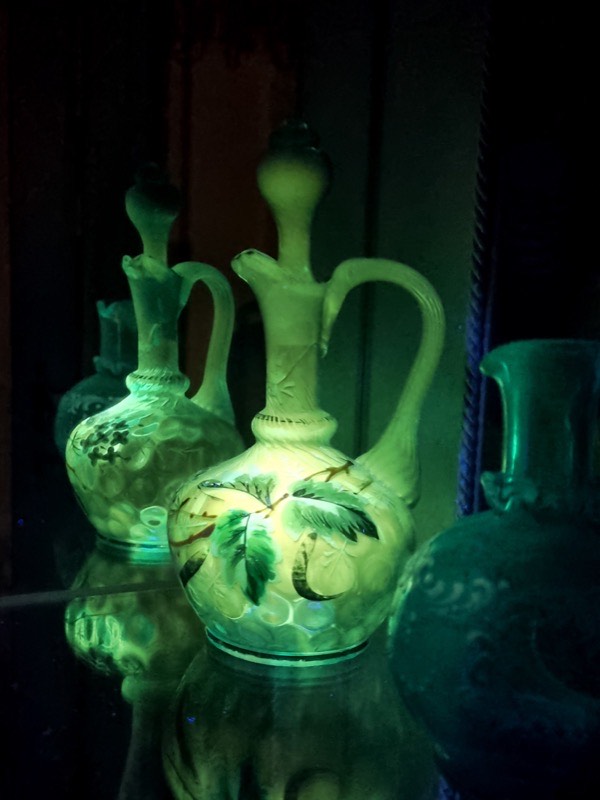
Uranium glass will register above background radiation on a sufficiently sensitive Geiger counter. That is a real measurement, and it is also why the internet periodically rediscovers this glass and panics about it.
But the reference position is that most pieces are "harmless and only negligibly radioactive". A study of a private collection measured the beta and gamma dose rates and concluded they posed no danger to the public or to conservators — the people handling it daily, at close range, for a living.
One honest gap: the standard reference doesn't address eating or drinking from uranium glass, which is the question people most often actually have. Dose from handling and dose from a leaching acidic liquid are different questions, and "nobody authoritative has said" is a more useful answer than a confident guess in either direction. Display it without a second thought; if you want to serve from it, that's a question this page can't settle for you.

What it's worth
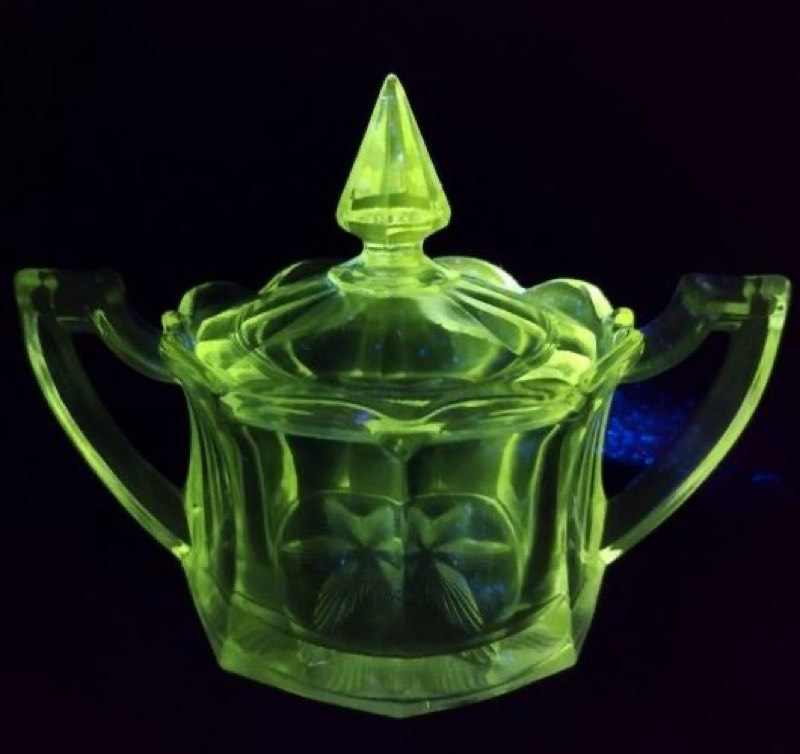
Most uranium glass sits in the antiques-and-retro-collectable bracket rather than the fine-glass one, and prices follow the usual logic: form, maker, condition and colour, not the uranium itself.
A great deal of it overlaps with depression glass — the mass-produced 1929–1939 glassware given away in food packaging, at cinemas and by businesses as a sales incentive, mostly made in the Ohio River Valley. More than twenty manufacturers produced over a hundred patterns. Some depression glass is uranium glass, which is why a blacklight is standard equipment at a glass sale.
Depression glass has been collected seriously since the 1960s and rare pieces reach several hundred dollars, though it was never high-quality glass to begin with. Popular patterns have been reproduced, and reproductions are still being made — a point worth dwelling on before paying a premium.
The better material is Elegant glass: a contemporaneous, genuinely higher-quality tier with polished mould seams, sold through jewellery and department stores. Makers included Cambridge, Duncan Miller, Fostoria and Consolidated Lamp and Glass. Most had closed by the end of the 1950s, undercut by cheap glassware and imported china.
There has also been a minor revival in studio glass art, so some of what glows on a shelf today was made recently and on purpose.
Sources & further reading
Everything above was researched from these. They're worth reading directly — we link out on purpose.
- Uranium glass — Wikipedia
Composition and the 2%/25% uranium figures, Klaproth's 1789 identification, Whitefriars, the WWII Manhattan Project confiscation and 1942–1958 restriction, Fenton and Mosser resuming, the Vaseline/custard/jadite/Burmese naming conventions including the differing UK and Australian usage, graded seals, and the radioactivity findings. Note it does NOT address eating or drinking from uranium glass. - Depression glass — Wikipedia
The 1929–1939 period, distribution as a promotional giveaway, Ohio River Valley manufacture, the colour range, that some depression glass is uranium glass, collecting since the 1960s, ongoing reproductions, and the Elegant glass tier and its makers.
Photographs are used under their stated licences; each is credited beneath the image. Last updated October 17, 2026.
Got one in your hands?
Snap a photo and our identifier will take a swing at what it is and roughly what it's worth.
Identify a piece → Find a shop near you → 🎲 Another one