
Pyrex
Clear and printed glass bakeware that started as railroad lantern glass and reached American kitchens because one scientist's wife needed something that wouldn't shatter in the oven. The collector obsession is whether a piece is borosilicate or soda-lime — and the rule most people use to tell them apart doesn't work.
Also called: PYREX · pyrex · Corning 7740 · borosilicate bakeware
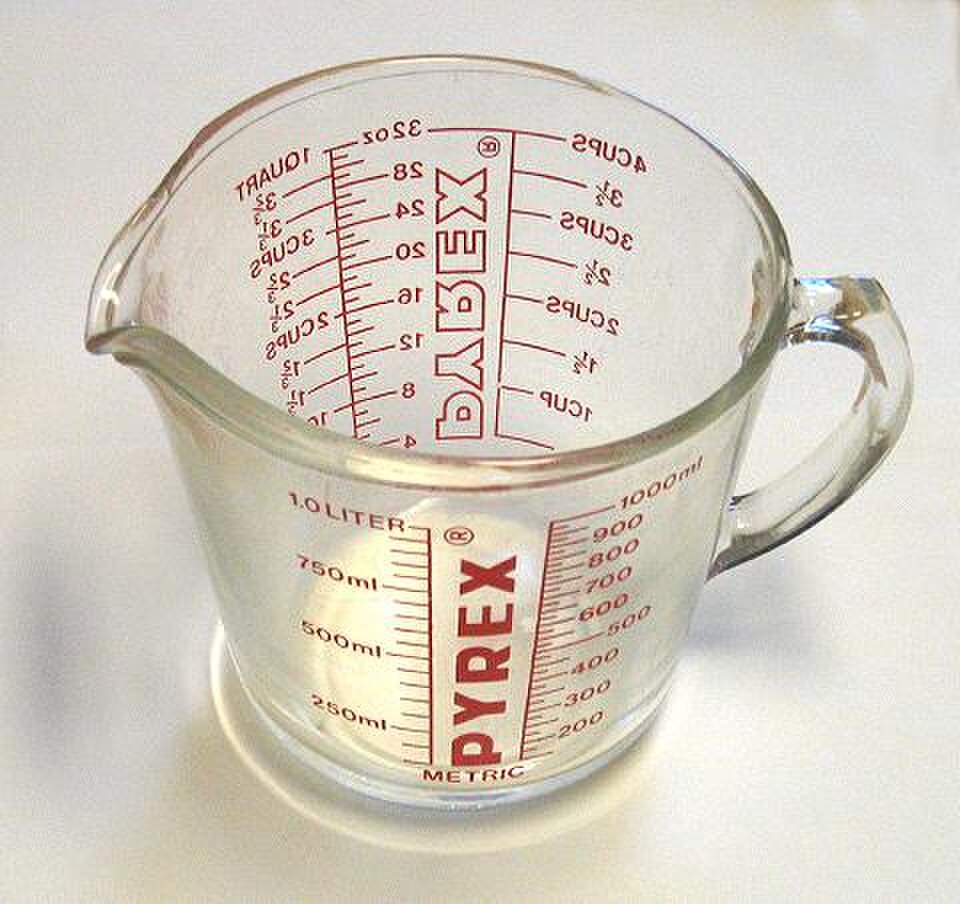

Where it came from
Borosilicate glass wasn't an American invention. The German chemist Otto Schott first made it in 1893, and it was sold in Europe as Duran. Corning's research director Eugene Sullivan had encountered Schott's work while studying in Leipzig, and in 1908 he, William Churchill and George Hollister developed a low-expansion glass of their own.
It was not meant for cooking. They called it Nonex — short for "non-expanding" — and it was made into railroad signal lantern globes and battery jars, things that cracked when cold rain hit hot glass.
The kitchen came later, and by accident. Corning scientist Jesse Littleton's wife Bessie had a ceramic casserole shatter in her oven. He brought home a cut-down Nonex battery jar for her to bake in. It worked. Corning pulled the lead out of the Nonex formula, and the company's first consumer product was a pie plate.
It reached the public in 1915, in the middle of a war with Germany, and was marketed hard as the American answer to German-made Duran. Early advertising pushed the pun "Pie Right" — which is where the name landed.
Borosilicate vs soda–lime: the thing collectors argue about
Early Pyrex was borosilicate. Starting somewhere around the 1940s–50s — the record isn't precise, and sources give both — Corning began making kitchenware from thermally tempered soda–lime glass instead. By the time the consumer division was sold in 1998, almost all of it had switched. The wider US industry followed in the 1980s, because soda–lime is cheaper to melt and work.
The two behave differently, and neither is simply better:
Borosilicate handles temperature change roughly three times better. Take it from fridge to hot oven and it is far less likely to fail. Soda–lime is about twice as strong mechanically — it survives being knocked against the sink, which is how most kitchen glass actually dies.

How to tell which one you have
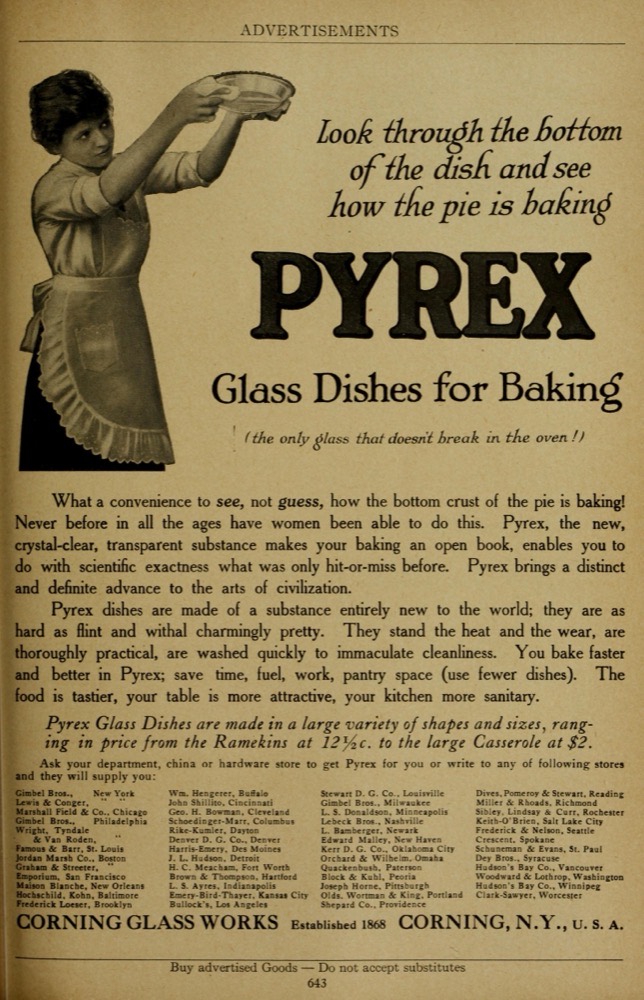
Start by ignoring the advice you'll see most often. The widely repeated rule is that uppercase PYREX means borosilicate and lowercase pyrex means soda–lime. It is not reliable, and the people who made the glass say so.
- The logo case — and why it misleads
- Lowercase pyrex was introduced in 1975 for kitchenware; uppercase PYREX stayed on laboratory glass. But any US Pyrex made between the 1940s and 1998 could be either glass, regardless of the logo. The Corning Museum of Glass states plainly that the case change "is not a conclusive way to determine, historically, what type of glass formulation the product is made from." Treat the logo as a dating hint, not a material test.
- Where it was made
- Geography is a better guide than typography. French-made Pyrex is borosilicate and carries the uppercase logo. Australian lowercase pieces include both soda–lime and borosilicate. All US Pyrex made since 1998 is soda–lime with the lowercase logo — that one isn't hedged.
- The blue tint
- Corning designer Herb Dann described the tempered soda–lime as "a little bluer glass." The cast comes from cobalt that wasn't removed from cheaper melts. Hold a piece against white paper next to another and the difference is visible; alone it's nearly impossible to judge.
- Maker stamps outside the US
- Pyrex was made under licence abroad and the marks differ. British pieces made before Corning took the brand over were stamped JAJ. Australian stamps shifted over time: "Crown Agee Pyrex" in the mid-1960s, "Agee Pyrex" until about 1969–70, "Crown Ovenware" in the mid-1970s. Many pieces carry no stamp at all, which proves nothing either way.
Is old Pyrex actually safer?
This is where collector lore and the evidence part company. The US Consumer Product Safety Commission logged 66 complaints of Pyrex shattering, and Consumer Reports testing in January 2011 confirmed that borosilicate bakeware is less prone to breaking under thermal stress. So far, so good for the old stuff.
But when the statistics group STATS examined how people were actually getting hurt, the most common cause was mechanical breakage — dropping and knocking — not thermal shock. That is the failure mode where soda–lime is the stronger glass. On the available data the switch represented a net safety gain, not a cost-cutting betrayal.
The honest summary: if you routinely move dishes between fridge and hot oven, older borosilicate has a real advantage. If your dishes mostly get dropped, the newer glass is tougher. Neither is a reason to distrust what's in your cupboard.

What it's worth
Plain clear Pyrex is worth very little. It was made in enormous quantities for seventy years and most of it still exists — a clear loaf pan or measuring cup is a few dollars.
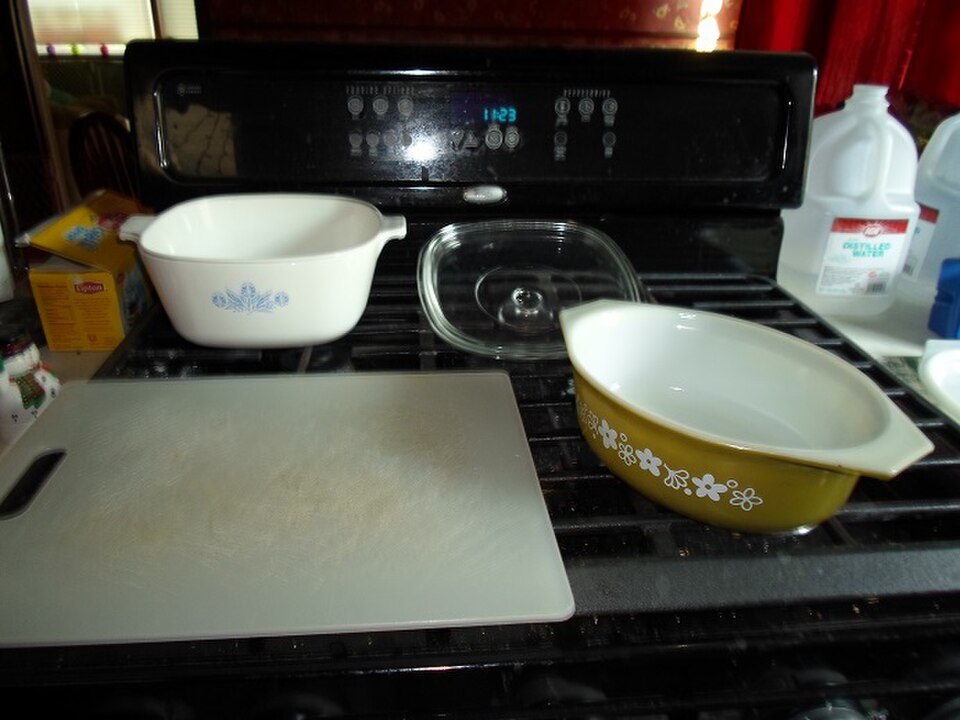
The money is in printed patterns, and it's driven by scarcity and fashion rather than the glass itself. Short-run and promotional patterns are the ones collectors chase; Pink Daisy (1956) and Colonial Mist (1983) are among the names that come up. Prices reported from the collector market run from around $100 for a single desirable piece to roughly $500 for a set, though that market moves fast and is driven as much by social media as by rarity.
Condition is unforgiving here. Dishwasher wear fades printed patterns permanently, and a faded piece is worth a fraction of a crisp one. Check the print under strong light before paying a pattern premium.

Looking after it
Hand wash printed pieces. Dishwasher detergent and heat are what destroys the patterns that carry the value — the damage is cumulative, invisible at first, and cannot be reversed.
Avoid extreme temperature changes regardless of which glass you have. Don't put a cold dish into a hot oven, don't set a hot dish on a wet or cold surface, and don't add cold liquid to a hot dish. Borosilicate is more forgiving of all three; it is not immune.
Sources & further reading
Everything above was researched from these. They're worth reading directly — we link out on purpose.
- Pyrex — Wikipedia
The Nonex origin, the Littleton battery-jar story, the 1915 launch, the borosilicate-to-soda-lime switch, the logo-case misconception and the Corning Museum of Glass statement, the CPSC/Consumer Reports/STATS safety findings, and the overseas maker stamps. - Borosilicate glass — Wikipedia
Otto Schott's 1893 invention, the Corning 7740 and Schott 8330 compositions, and the thermal-shock and mechanical-strength comparisons between the two glasses. - Corning Inc. — Wikipedia
Corporate history and the 1998 spin-off of the consumer products division. - Corning Museum of Glass — Corning Museum of Glass
Quoted via the Pyrex article for the statement that logo capitalisation does not reliably identify the glass formulation.
Photographs are used under their stated licences; each is credited beneath the image. Last updated October 17, 2026.
Got one in your hands?
Snap a photo and our identifier will take a swing at what it is and roughly what it's worth.
Identify a piece → Find a shop near you → 🎲 Another one