
Milk Glass
Opaque glass — usually white, but also blue, pink, yellow, brown and black — made opaque by adding an opacifier to the batch. It started in 16th-century Venice as a cheap stand-in for Chinese porcelain and ended up on half the dining tables in mid-century America. Most of it is worth a few dollars. A little of it is worth hundreds, and the difference is mostly age, maker and pattern.
Also called: opal glass · lattimo · opaline · white glass
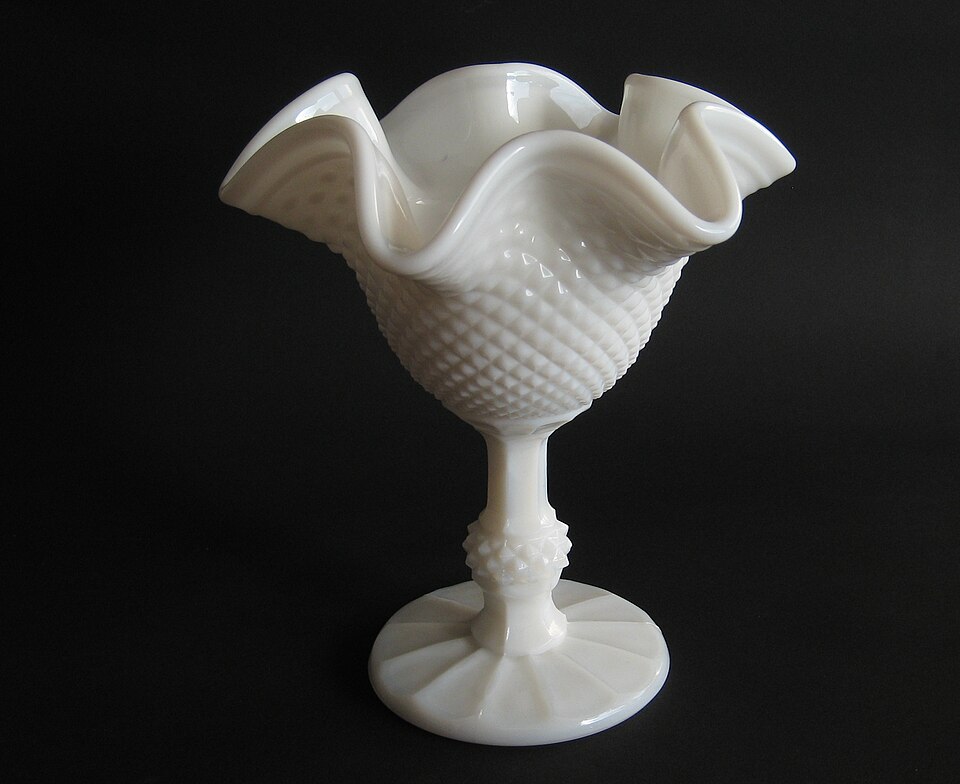

What milk glass actually is
Milk glass isn't a brand, a maker or a single recipe. It's a category: any glass made deliberately opaque rather than clear. The name is modern — it describes the look, not the chemistry.
The opacity is physics, not paint. Glassmakers add an opacifier to the molten batch: historically bone ash (calcium phosphate), tin dioxide, or arsenic and antimony compounds. These form particles suspended in the glass whose refractive index differs sharply from the glass around them. Light hitting those particles scatters instead of passing through — the same Tyndall scattering that makes smoke look blue and milk look white.
Change the size, spread and density of those particles and you change the result. Dense and even gives you flat opaque white. Sparse gives you something closer to opalescent, where light still gets through at the edges. That partial-scatter effect is the whole basis of the "ring of fire" dating test further down this page.
A short history
16th century, Venice. Venetian glassmakers developed lattimo — from latte, milk — explicitly as a competitor to the Chinese porcelain flooding European markets. Porcelain was expensive and imported; opaque white glass looked similar and could be made locally. It was an imitation luxury from day one, which is a theme that never really goes away.
Gilded Age America. Milk glass found its real mass market in the United States in the late 19th century, through the fin de siècle and into the 1910s. Pressed-glass technology made it cheap to produce decorative objects in volume — covered animal dishes, compotes, lamp shades, dresser jars.
The Depression and after. A second wave arrived in the 1930s and 1940s alongside Depression glass production, then peaked commercially in the 1950s and 60s when Fenton's Hobnail line put milk glass in ordinary American houses by the truckload. This is the era most of what you'll find at a thrift store comes from, and it's why so much milk glass is common and inexpensive.
It wasn't only tableware. Milk glass was used architecturally for its even, glare-free glow — the clock faces at New York's Grand Central Terminal are milk glass, as was the original marquee of the Chicago Theatre, now in the Smithsonian's collection.
How to identify and date it
There's no single test that settles it. Work through several and let them agree.
- The "ring of fire"
- Hold a thin edge — a rim or a handle — up to strong light and look for an iridescent halo of red, orange, pink or blue. It comes from the opacifier scattering light where the glass is thinnest, and it shows up most on earlier formulations, particularly pre-1900 pieces. Treat it as a clue, not proof. Plenty of collectors cite it as definitive; it isn't. Some later glass shows it and some genuinely old glass doesn't.
- Maker's marks — and their absence
- Most early milk glass is completely unmarked, and that doesn't make it fake. American makers largely didn't start marking until the 1950s–70s. Fenton didn't emboss its oval "Fenton" logo until 1970. Westmoreland used an interlaced "WG" on much mid-century output. So an unmarked piece may be older than a marked one, which is the opposite of most people's instinct.
- Weight and feel
- Older pressed pieces tend to feel heavier and denser than modern reproductions of the same form. Run a finger around the rim and foot — early pressed glass often has mold seams you can feel, and sometimes slight asymmetry. Flawless uniformity suggests recent manufacture.
- Color temperature
- Early milk glass often reads warmer and slightly creamier; a lot of later mass-market white is colder and flatter. Compare two pieces side by side in daylight — the difference is obvious together and nearly invisible alone.
- The pattern itself
- Pattern is usually the fastest route to a maker and a date range, because catalogs survive. Identify the pattern first, then confirm with the physical checks above.
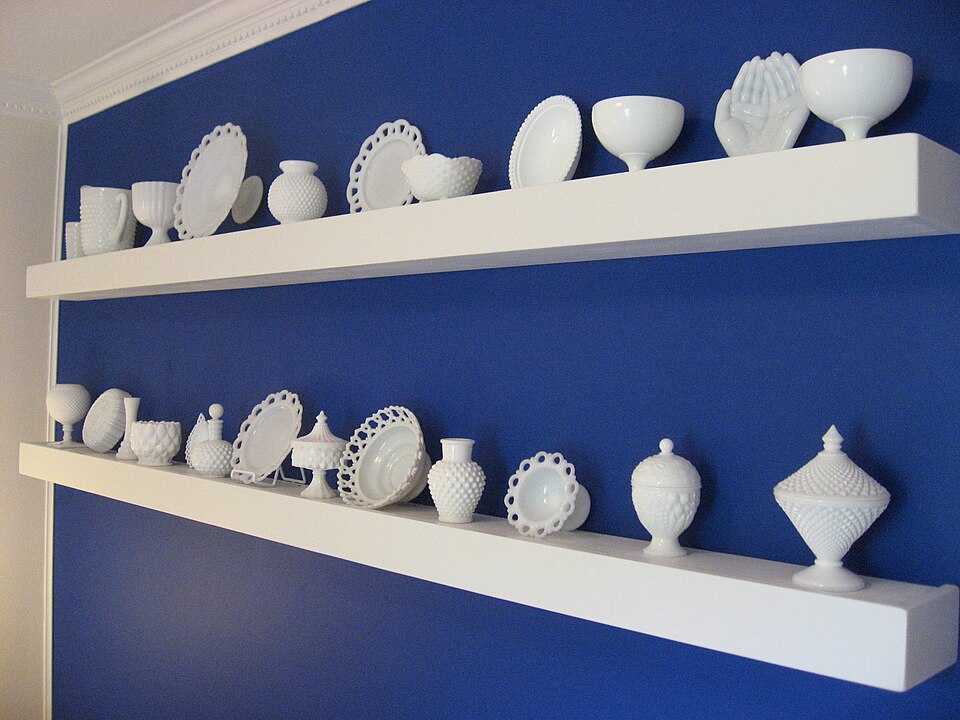

The makers worth knowing
Dozens of companies made milk glass. These are the names that come up most often, and the ones that most affect value.
| Maker | Years | Marks | Notes |
|---|---|---|---|
| Fenton Art Glass | 1905–2011 | Oval "Fenton" mark from 1970; unmarked before | The giant of mid-century milk glass. Its Hobnail line is the single most recognisable American milk glass pattern, and also the most common — which keeps most Hobnail inexpensive. |
| Westmoreland Glass | 1889–1984 | Interlaced "WG"; earlier output unmarked | Known for quality and for grape-motif and lattice-edge patterns. Generally better regarded by collectors than its price suggests. |
| Fostoria Glass | 1887–1986 | Varies; often unmarked | Primarily a fine-tableware maker; its milk glass is less common than its crystal. |
| Imperial Glass | 1901–1984 | "IG" monogram on later pieces | Large producer; also made carnival glass, so pieces turn up in both collecting worlds. |
| L.E. Smith Glass | 1907–2004 | Often unmarked | Produced a lot of mid-century milk glass, including animal-form covered dishes. |
| Anchor Hocking | 1905–present | Varies by line | Its Fire-King range overlaps with milk glass in the public mind; strictly, much of it is a different opaque-glass formulation. |
What it's worth
Be realistic. The overwhelming majority of milk glass you'll encounter is worth between five and forty dollars, because it was made in enormous quantities for ordinary households and most of it survived. A Fenton Hobnail vase is a lovely object and a poor investment.
Value concentrates in a few places: genuinely early pieces (pre-1900), scarce patterns, large or complex forms like covered animal dishes and pedestal compotes, unusual colors — blue and pink carry a premium over white — and pieces in complete sets. Condition matters more than collectors admit: chips to a rim or foot can cut a price by half or more.
Treat any single sold listing with suspicion. Look at a spread of completed sales for the same pattern and form before deciding what you have.

Reproductions and honest mistakes
Milk glass is reproduced constantly, and much of it isn't fraud — companies reissued their own patterns for decades, and some molds were sold on and run by other firms entirely. A piece can be a genuine Westmoreland mold, pressed in 1990, and be exactly what it appears to be while being worth a fraction of the 1890s version.
The more common error is simpler: a lot of white glass isn't milk glass at all. Opaque white porcelain, modern white-painted clear glass, and various mid-century opaque formulations all get lumped in. Painted glass gives itself away — check for wear or chipping that reveals clear glass underneath, especially around the base and rim.
Caring for it
Hand wash in warm water with mild soap. Keep it out of the dishwasher — heat cycles and harsh detergent can dull the surface permanently, and that haze doesn't come back.
Don't take abrasives to it. For stubborn interior film in vases, a soak in warm water with a little white vinegar usually does it. Avoid sudden temperature changes; old glass can have internal stresses and thermal shock will find them.
Sources & further reading
Everything above was researched from these. They're worth reading directly — we link out on purpose.
- Milk glass — Wikipedia
Origins in 16th-century Venice, opacifier chemistry and Tyndall scattering, color range, maker list, and the Grand Central and Chicago Theatre uses. - Opacifier — Wikipedia
How opacifying agents scatter light, and which compounds are used in glass. - A Complete Guide to Milk Glass (History & Values) — Adirondack Girl @ Heart
Collector-side history and value context for common mid-century pieces. - Identifying Milk Glass: Why Some White Glass is Worth Hundreds — Antique Identifier Online
The ring-of-fire test and the caution that it is an indicator rather than proof of age. - Milk Glass Identification: Fenton, Westmoreland, and More — identifyantiques.app
Maker marks and dating — Fenton's 1970 oval mark, Westmoreland's WG, and the fact that most early glass is unmarked. - Milk Glass Glassware 101: Identification, Care, and Decorating — The Antiqued Journey
Care and cleaning guidance, and practical identification tips.
Photographs are used under their stated licences; each is credited beneath the image. Last updated October 2, 2026.
Got one in your hands?
Snap a photo and our identifier will take a swing at what it is and roughly what it's worth.
Identify a piece → Find a shop near you → 🎲 Another one