
Cast Iron Cookware
The only cookware category where the hundred-year-old version is genuinely usable daily, and often preferred. Cast iron barely changed for a century, nearly died in the 1970s, and came back. Most of what collectors argue about — soap, tomatoes, the magic of old pans — is more complicated than either side admits.
Also called: cast iron skillet · spider · Dutch oven · hollowware
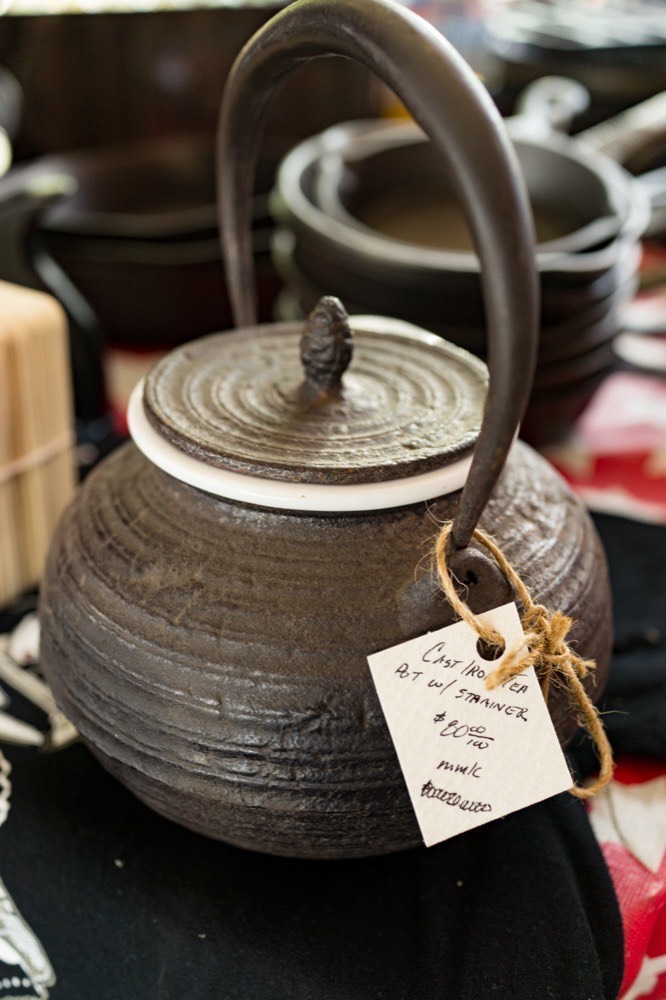

A pot with legs, and why that matters
Cast iron is old. The first mention of a cast-iron kettle in English dates to 679 or 680, and the word "pot" enters the language around 1180. What people actually cooked on, though, was fire — and the shape of the cookware followed from that.
Early pots were built either with a bail handle, to hang over a fire, or with legs, to stand directly in the coals. The legged frying pan had its own name: a spider. If you find a three-legged pan at a sale, that's what you're looking at, and it predates the kitchen you'd use it in.
Abraham Darby I patented a method of producing legged Dutch ovens in 1708, and the form stayed essentially fixed for the next two centuries.
Flat-bottomed pans are the modern shape, and they only make sense once you have a cooking stove with a flat surface — which is to say, the late 19th century. That single detail dates a huge amount of cast iron at a glance: legs mean hearth, flat means stove.
The American makers
The names that drive the collector market are American foundries from a seventy-year window.
Griswold is the one everybody wants. It was founded in Erie, Pennsylvania in 1865 as the Seldon-Griswold Manufacturing Company by Matthew Griswold and his cousins, the Selden brothers. By the 1870s it was making skillets, pots, grinding mills and waffle irons, and it stayed in business until 1957.
Wagner followed in 1891 and Blacklock Foundry in 1896 — Blacklock being the ancestor of Lodge, which is still running.
Enamelled cast iron is a separate tradition with its own names: Le Creuset, Staub, Descoware, Cousances and Druware. Expect enamelled pieces to cost three or four times the bare equivalent.
Dating a Griswold by its logo
Griswold changed its mark several times, which gives you an unusually clean dating ladder — rare in a category where most pieces carry little more than a size number.
- Block lettering, 1920s–1930s
- The large block logo is the most recognised Griswold mark, to the point where it functions as the generic image of antique American cast iron. If you've seen a picture of a collectible skillet, you've probably seen this.
- The "small logo", early 1940s onward
- Griswold shrank the mark considerably in the early 1940s. Collectors call these "small logo" pieces, and they were produced until the company was bought by the Randall corporation in 1957.
- Dual Griswold/Wagner marks, early-to-mid 1960s
- After both brands ended up under the same ownership, a run of pans was produced carrying both logos. A dual-marked pan is therefore post-1960 — useful, because it rules out the earlier dates people hope for.
- Unmarked pieces
- Plenty of good cast iron carries no maker's mark at all, only a size number and sometimes a foundry letter. Unmarked does not mean worthless, and it does not mean recent — it usually just means it wasn't Griswold.
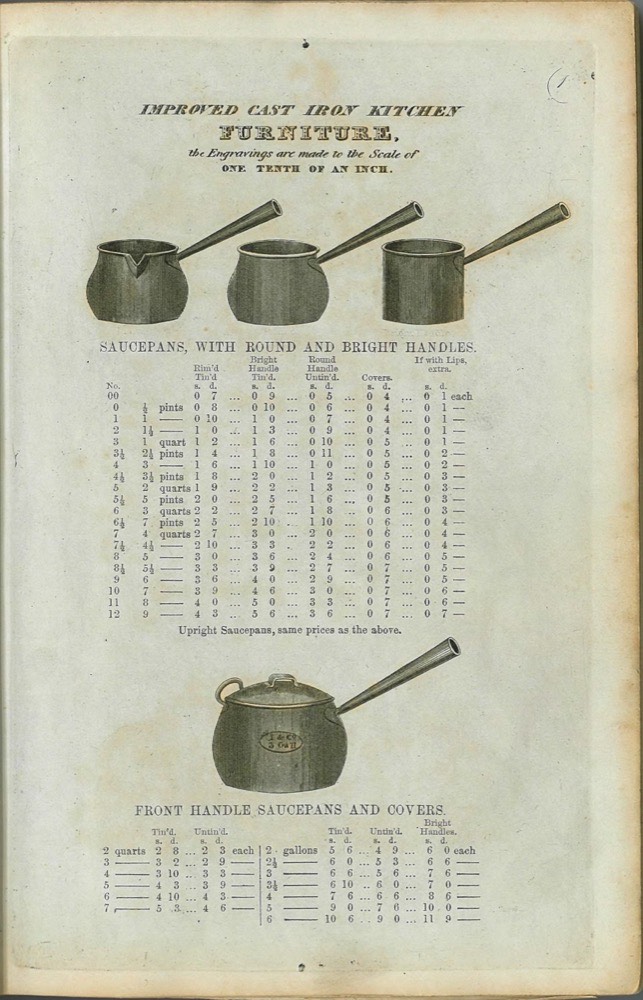

What seasoning actually is
Seasoning is not a layer of grease. It's a polymer. Thin coats of oil or fat are heated until they oxidise and cross-link into a hard, hydrophobic film bonded to the iron, built up over repeated layers. The darkening you see with use is the patina of that film thickening.
The temperature advice varies enormously between sources — recommendations run from above 260 °C (500 °F) down to below 150 °C (302 °F), which is a wide enough spread that any single confident number should be treated with suspicion.
There's also a genuinely different tradition. Some Chinese cookware is seasoned at around 450 °C, which is closer to bluing than to conventional seasoning: it chemically alters the iron surface itself rather than building a layer of oil on top. Heating beef tallow at that temperature drives oxygen to the surface and forms magnetite (Fe3O4). The traditional process often includes Chinese chives or scallions.
A new pan may arrive pre-seasoned, or coated in protective wax or shellac that has to be scoured off first. Lodge states it uses a soybean-oil blend for its base coat, though essentially any cooking fat will work.
The soap argument, settled
"Never use soap on cast iron" is a misconception. It's advice repeated by some food writers and inherited from an era of harsh lye-based detergents, and it does not describe modern dish soap. Testing by America's Test Kitchen found that small amounts of soap do not damage the seasoning on a well-seasoned pan.
What does strip it: a dishwasher. That one is not in dispute — the combination of heat, time and detergent concentration will take the coating off.
Acidic food is the more nuanced case. Prolonged exposure to tomatoes and similar ingredients does degrade seasoning over time, and some writers advise avoiding them entirely. But America's Test Kitchen found short cooking times had no noticeable effect. A quick tomato sauce is fine; a long simmer is how you end up re-seasoning.
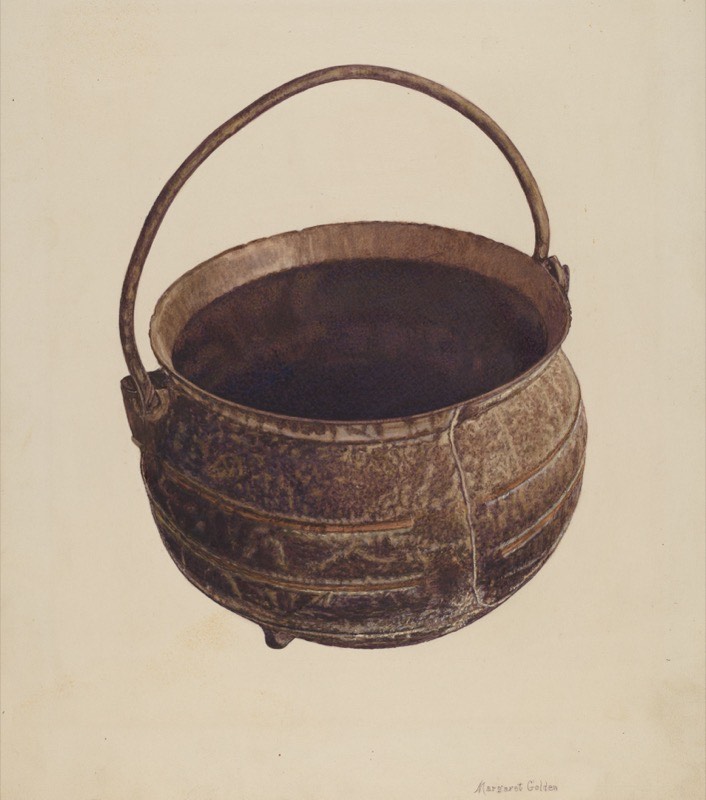

Iron in your food — and one real warning
Cast iron leaches iron into what you cook, measurably. An American Dietetic Association study found the effect is large with acidic foods: iron in spaghetti sauce rose 845% (0.61 to 5.77 mg per 100 g), while cornbread rose a modest 28% (0.67 to 0.86 mg). America's Test Kitchen found an unseasoned skillet leached far more into tomato sauce than a seasoned one — seasoning is a barrier as well as a non-stick surface.
For most people that's neutral or mildly beneficial, and people with iron deficiency may benefit. People with haemochromatosis — iron overload — are advised to avoid cast iron entirely, for the same reason.
A caveat on these numbers, honestly: the widely-quoted leaching figures trace back through Wikipedia to a cookware-restoration website rather than to the study itself. The direction of the effect is well established; treat the exact percentages as indicative rather than clinical, and don't make a medical decision on them.
The warning that matters more is about enamel. Some enamelled cast iron — particularly older, imported or unbranded pieces — can leach cadmium and lead from the coating into food. If you're buying vintage enamelled cookware to cook in rather than display, that is worth taking seriously, especially with chipped or crazed glaze.
The crash, and the comeback
Cast iron was close to universal in American kitchens through the first half of the 20th century. Then Teflon-coated aluminium arrived, and cast iron fell out of fashion through the 1960s and 70s. The collapse in everyday use is credited with closing nearly all the American iron cookware manufacturers.
One honest caveat on that story: the source material contradicts itself. The same passage that dates the decline to the 1960s and 70s also says many makers went out of business in the 1920s, and the section carries no citation. The broad shape — dominance, then collapse, then revival — is solid; the precise timeline is not as settled as it's usually told.
The revival is recent and real, driven by cooking shows and chefs rediscovering the material, with new small manufacturers entering the market in the 2010s. Which is why a 1930s skillet is worth money again: it never stopped working.
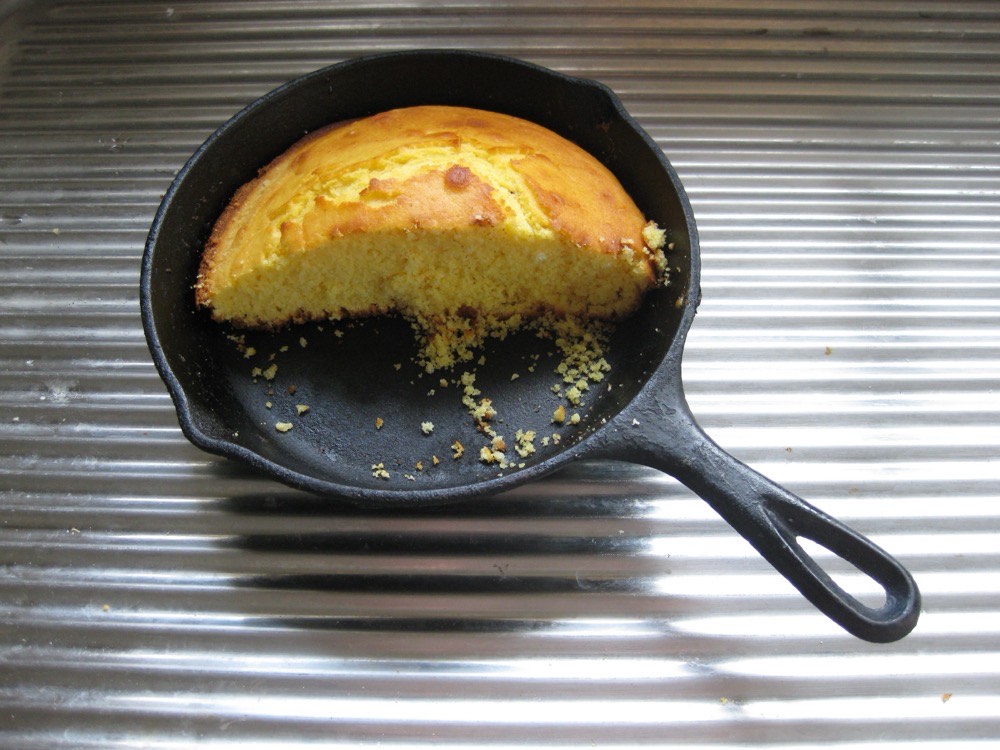

Buying and keeping it
Rust is cosmetic; cracks are fatal. Surface rust comes off with a vinegar bath or electrolysis and the pan is fine. A crack, a warped base that rocks on a flat surface, or a deep pitted cooking face are the things to walk away from.
Old seasoning and carbon build-up can be stripped with lye, oven cleaner, or a self-cleaning oven cycle, then re-seasoned from bare metal. A black, scabby pan at a flea market is often a good pan under the crust.
Avoid thermal shock with enamelled pieces especially — adding cold water to a hot enamelled pot, or dropping it, will chip the coating, and the chip is permanent.
Cast iron suits high-fat cooking: frying, bacon, sausage, cornbread. It is poor at long acidic simmers, which is what enamelled cast iron exists to solve.
Sources & further reading
Everything above was researched from these. They're worth reading directly — we link out on purpose.
- Cast-iron cookware — Wikipedia
The 679/680 kettle reference, the spider and legged forms, Darby's 1708 patent, the maker dates, the soap and acidic-food findings from America's Test Kitchen, the iron-leaching figures, and the enamel cadmium/lead warning. Note its History section is flagged as needing citations and contradicts itself on when makers closed. - Seasoning (cookware) — Wikipedia
What polymerised seasoning is and how it forms, the wide range of recommended temperatures, the higher-temperature Chinese method closer to bluing, magnetite formation, and stripping and rust-removal methods. - Griswold Manufacturing — Wikipedia
Founding as Seldon-Griswold in Erie in 1865, Matthew Griswold, the product range from the 1870s, the logo sequence used for dating, and the 1957 Randall acquisition. - America's Test Kitchen — America's Test Kitchen
Cited via the articles above for the soap, acidic-food and comparative iron-leaching tests.
Photographs are used under their stated licences; each is credited beneath the image. Last updated October 17, 2026.
Got one in your hands?
Snap a photo and our identifier will take a swing at what it is and roughly what it's worth.
Identify a piece → Find a shop near you → 🎲 Another one